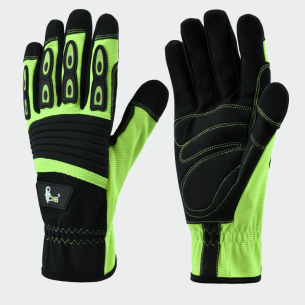
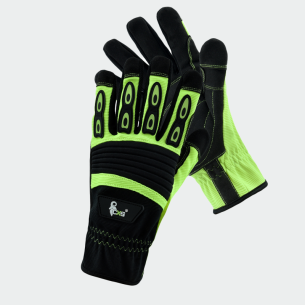
Hands take part in almost every movement at work, which is why they are injured most often: cuts, abrasions, burns, chemical burns, frostbite. Protective gloves are the simplest means against these risks, but only if they protect against exactly the risk present in the workplace. A glove that stops a knife blade may let a solvent through within minutes. A glove that withstands acid will not withstand hot metal.
That is why gloves differ in two ways: what they are made of and what they have been tested against. The material can be seen with the naked eye. The tests are read from the pictograms and numbers on the glove or its packaging. In this article we explain the main types, what the markings under the European standards mean, and how to use and care for gloves so that they really protect.
How to determine what protection is needed
Protective gloves are personal protective equipment under Regulation (EU) 2016/425. The regulation divides them into three categories according to risk:
- Category I for minimal risks, for example superficial mechanical injuries, mild cleaning agents, prolonged contact with water and hot surfaces up to 50 °C;
- Category II for risks that are neither minimal nor serious, for example mechanical injuries and cuts;
- Category III for risks that can lead to serious harm or death: hazardous chemicals, biological agents, environments with a temperature of at least 100 °C or minus 50 °C and below, electric shock and work under voltage, cuts from a chainsaw.
The higher the category, the stricter the assessment the glove goes through. Which level of protection is needed is determined in the workplace risk assessment, not out of habit. You can read more about the employer’s obligations in our article on the regulation on personal protective equipment.
Every protective glove must also meet the general requirements of EN ISO 21420 (which replaced EN 420): harmless materials, size, dexterity, instructions for use. On top of these come the standards for the specific risk.
The main types of gloves

Knitted and textile gloves
Knitted gloves made of cotton, polyester or a blend protect from dirt, light abrasion and cold or dusty objects. They are comfortable and breathe, but on their own they do not protect from cuts, liquids and chemicals. They often serve as the base for dipped gloves. The types are in the knitted gloves section.
Dipped gloves
In these, the knitted base is dipped in a coating on the palm and fingers. The coating provides grip and protects from abrasion, while the back stays open and the palm does not sweat as much.
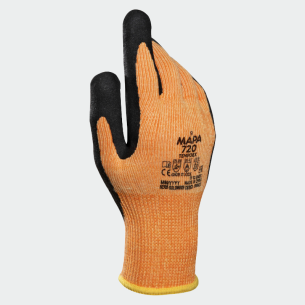
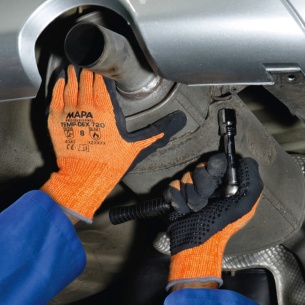
- Nitrile coating withstands oils and greases, which is why it is used in car workshops, metalworking and assembly. Porous (foam) nitrile keeps its grip even on oily parts.
- Latex coating is elastic and grips wet and rough surfaces well, for example bricks, stone and glass. For people allergic to latex, another material is used instead.
- Polyurethane coating is thin and keeps the sensitivity of the fingers. It is suitable for precise dry work: assembly, sorting, handling small parts.
You can read more about the difference between the two most common materials in our article nitrile or latex gloves, and the types of coatings are in the dipped gloves section.
Leather gloves
Leather withstands abrasion, rough and heavy objects and short contact with heat. Grain leather is smoother and gives better dexterity, while split leather is rougher and more resistant to abrasion. Leather gloves are not waterproof unless specially treated, and do not protect from chemicals. The types are in the leather work gloves section.
Cut-resistant gloves
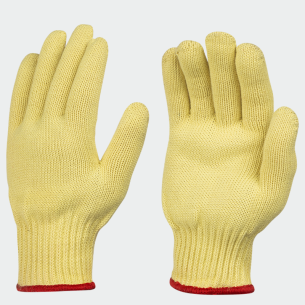
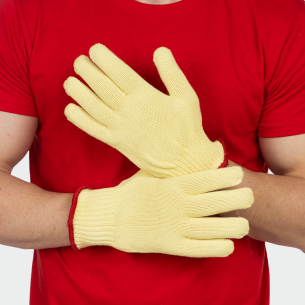
They are knitted from high-strength fibres, for example HPPE (ultra-high-molecular-weight polyethylene), aramid or yarns with glass or steel fibre. They are used when working with sheet metal, glass, knives and sharp parts. The level of cut protection is read from the EN 388 marking, which we cover below. The types are in the cut-resistant gloves section.
Chemical protection gloves
They are made of nitrile, neoprene, butyl, PVC or combinations. Each material withstands different substances differently, so with chemicals the specific substance is what matters, not simply “chemical resistance”. The types are in the chemical protection gloves section.
Disposable gloves
Thin nitrile, latex and vinyl gloves protect the hands and the product from contamination during short tasks: in healthcare, cosmetics, the food industry and cleaning. Medical examination gloves comply with EN 455. If they are used as protection against chemicals or microorganisms, they must also carry an EN ISO 374 marking. The types are in the disposable gloves section.
Heat-protective gloves and welding gloves
Heat-protective gloves protect on contact with hot surfaces, in ovens, foundries and bakeries. Welding gloves are made of leather, usually with a long cuff, and protect from molten metal spatter and heat. They are in the heat-protective gloves and welding gloves sections.
Winter gloves
Winter work gloves have thermal lining and often a waterproof coating. They protect from cold air and cold objects when working outdoors, in cold stores and in construction during winter.
How to read the markings
On a protective glove there is a pictogram for each risk it has been tested against, with numbers or letters beneath it. The number 0 means the glove was tested but did not reach the lowest level. The letter X means that no test was carried out or that it does not apply to this glove.
EN 388: mechanical risks
The pictogram is a hammer with a shield. Beneath it there are up to six characters, for example 4X43C or 4X42FP:
| Position | What it shows | Scale |
|---|---|---|
| 1 | Abrasion resistance | 0 to 4 |
| 2 | Cut resistance by the rotating blade method (Coup test) | 0 to 5 or X |
| 3 | Tear resistance | 0 to 4 |
| 4 | Puncture resistance | 0 to 4 |
| 5 | Cut resistance by the ISO 13997 method (TDM) | A to F |
| 6 | Impact protection (only if tested) | P |
For cut-resistant gloves, the fifth position is the most important. With strong fibres the rotating blade becomes blunt and the result is inaccurate, so for them the letter is what counts. It shows the force in newtons at which the blade cuts through the material: A is at least 2 N, B at least 5 N, C at least 10 N, D at least 15 N, E at least 22 N and F at least 30 N. Level A or B is enough for light tasks, while for work with sheet metal and glass, C and above is usually required.
EN ISO 374: chemicals and microorganisms
The pictogram is a flask. EN ISO 374-1 sets the requirements for how long it takes for a substance to pass through the material (the test is by the EN 16523-1 method). Beneath the flask is type A, B or C. For types A and B, the letters of the tested chemicals are shown beneath it, while for type C there are no letters and the data is in the instructions:
- Type A: at least 30 minutes of protection against at least 6 chemicals from the list;
- Type B: at least 30 minutes of protection against at least 3 chemicals;
- Type C: at least 10 minutes of protection against at least 1 chemical.
The letters stand for specific substances. For example, K is sodium hydroxide 40%, L is sulphuric acid 96%, J is n-heptane, and P is hydrogen peroxide 30%. The full list is in the instructions for the glove, which also state how many minutes it withstands each substance. If the substance you work with is not on the list, you need information from the manufacturer about it.
The separate biohazard pictogram shows protection from microorganisms under EN ISO 374-5. If VIRUS is written beneath it, the glove has also been tested against viruses.
EN 407: heat and fire
The pictogram has a flame if the glove has also been tested against burning. If not, the pictogram is for heat only, without a flame. The numbers show six types of protection: against burning, contact heat, convective heat, radiant heat, small and large splashes of molten metal. For contact heat, level 1 means testing at 100 °C, level 2 at 250 °C, level 3 at 350 °C and level 4 at 500 °C, with the inner side of the glove not heating up by 10 °C sooner than 15 seconds.
EN 511: cold
The pictogram is a snowflake. Three characters show protection from convective cold (cold air), contact cold (cold objects) and water permeability (0 or 1).
EN 12477: welding
Welding gloves are divided into type A and type B. Type A protects more and is used for all kinds of welding and cutting except TIG, for example manual arc and MIG/MAG welding. Type B is thinner and gives better dexterity, which is why it is preferred for TIG welding, where the hand has to feel the workpiece.
Practical tips for use
- Size is part of the protection. A large glove snags and reduces grip, while a small one tears and tires the hand. Sizes under EN ISO 21420 range from 4 to 13 and are determined by the circumference of the palm and the length of the hand.
- Do not wear gloves near rotating parts. With a drill, lathe or conveyor belt, the glove can be caught and pull the hand in. There, the rules for the machine determine whether gloves are used at all.
- With chemicals, time matters. Laboratory values are at room temperature. At a higher temperature, when the glove is stretched and with a mixture of substances, the protection may be shorter. A glove that has been in contact with a chemical is taken off without touching the outside with a bare hand, and replaced.
- Two gloves one over the other are used when one does not cover all risks, for example a cut-resistant glove under a chemical-resistant one.
- A disposable glove is single-use. It is not washed or reused, but replaced for every new task or when it tears.
Common problems and what to do
| Problem | Likely cause | What to do |
|---|---|---|
| Hands sweat and the skin turns red | Fully coated glove for long work, latex allergy or an allergy to chemicals in the skin | Use a glove with a breathable back, cotton gloves underneath, or another material |
| The glove slips on oily parts | The coating is not for oil, for example latex | Use a nitrile coating, preferably foam |
| The coating cracks or swells | Contact with a substance the material does not withstand | Replace the glove and check the list of tested chemicals |
| The cut-resistant glove gets cut through | The EN 388 level is too low for the task | Compare the letter from A to F with the risks in the workplace |
| Fingers get cold despite the winter glove | Wet lining or a tight size | Use a waterproof model and a suitable size, change wet gloves |
| The glove wears out quickly | Unsuitable material for rough and heavy objects | Use leather or a coating that is more resistant to abrasion |
Care and replacement
Reusable gloves are cleaned according to the manufacturer’s instructions. Leather gloves are not machine washed unless the label allows it, because they harden and shrink. Dipped and textile gloves can often be washed, but after washing it is checked whether the coating has cracked. They are stored dry, away from sunlight and heat sources.
A glove is replaced when it is punctured, torn, hardened or cracked, when it is contaminated with a substance that cannot be cleaned off, and when the marking can no longer be read. General guidance on the shelf life of personal protective equipment can be found in our article what personal protective equipment is needed according to the risk and work activity.
All types of protective gloves are collected in the work gloves section. On gloves from our own BWOLF brand, the 3D Grip technology for a more secure grip is also marked, described on the Technologies page.