

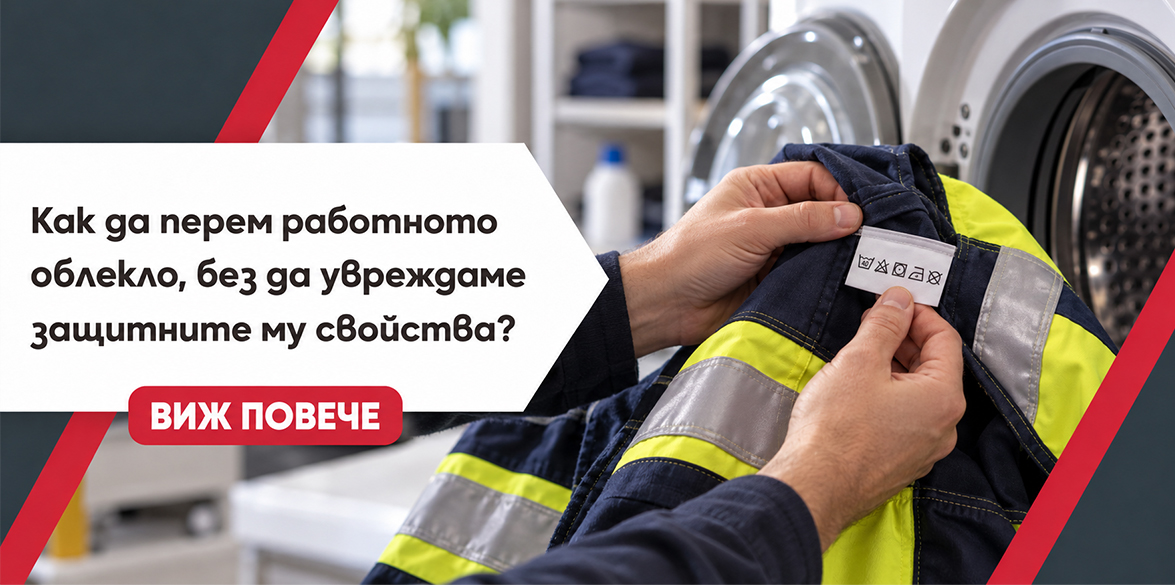
For most work clothes, an ordinary liquid detergent without bleaching additives, washing at the temperature on the label and no fabric softener is fine. Special clothing, however, has its own rules. Chlorine, optical brighteners and excessively high temperatures reduce the visibility of high-visibility clothing. Membranes and water-repellent fabrics are not washed with powder or fabric softener. Flame-resistant clothing is washed separately and without bleach. The label on the specific garment always comes first, because it describes the conditions under which the garment was tested.
Below you will see when workwear needs a special regime, how to read the care symbols, which detergent to choose, how to wash step by step and how to tell that a garment no longer protects.
When Workwear Needs a Special Washing Regime
Ordinary cotton or blended workwear stands up to washing quite well. Special care is needed when the garment has a protective function that depends on the surface or structure of the fabric:
- fluorescent background and reflective tape, which determine how early a driver will see you;
- water-repellent coating and membrane in rain and wind jackets and trousers;
- flame-resistant fibers or treatment in clothing for welders and work near open flames;
- antistatic threads in clothing for areas with a risk of sparks or for electronics;
- taped seams, tapes and badges that peel off at high temperatures.
With these garments, washing is not just a question of cleanliness. The wrong detergent or a higher temperature can reduce the very property the garment is worn for, without it being visible right away.
There are also cases where clothing should not be washed at home at all. If it is contaminated with hazardous substances, it is washed according to the procedure set at the workplace. For asbestos, Bulgarian Ordinance No. 9 of 2006 requires work and protective clothing to be stored at the company and washed at specially equipped facilities, transported in closed containers (Art. 10, para. 5). When working with biological agents, contaminated clothing is removed when leaving the work area, and its decontamination and cleaning are provided by the employer (Ordinance No. 4 of 2002, Art. 10). Cleaning, washing and maintenance of personal protective equipment are also organized by the employer and at the employer's expense (Ordinance No. 3 of 2001, Art. 19).

How to Read the Symbols on the Label
Care symbols are governed by the ISO 3758 standard, the current edition of which dates from 2023. They are always arranged in the same order: washing, bleaching, drying, ironing and professional cleaning. A cross over a symbol means that treatment is prohibited.
Temperature and Program
The tub with a number shows the maximum washing temperature in degrees Celsius. One bar under the tub means a gentler program with less mechanical action, and two bars mean a very gentle program. A hand in the tub means hand wash only. The temperature on the label is an upper limit, not a recommendation. If the garment is not heavily soiled, a lower temperature usually extends the life of tapes and colors.
Do not wash all your work clothes at the same temperature. A 100% cotton T-shirt and a high-visibility jacket with tape can have completely different limits, even if they come from the same set.
Bleaching and Dry Cleaning
An empty triangle means bleaching is allowed. A triangle with two diagonal lines allows only oxygen bleach, not chlorine. A crossed-out triangle prohibits any bleaching. The circle refers to professional cleaning: the letter P or F shows the permitted solvent for dry cleaning, and W means professional wet cleaning.
Drying and Ironing
The square is the drying symbol. A circle in the square means tumble dryer, and the dots inside show the heat level: one dot is for reduced temperature. Lines in the square mean natural drying, for example on a line or flat, and a diagonal line means drying in the shade. For ironing, the dots in the iron show low, medium and high temperature. Reflective tape is generally not ironed, even if the fabric itself allows it.
| Symbol | What it means | Workwear example |
|---|---|---|
| Tub with 40 and one bar | Wash up to 40 °C on a gentle program | Jacket with reflective tape |
| Triangle with two lines | Oxygen bleach only | Colored work trousers |
| Crossed-out triangle | Do not bleach | High-visibility and flame-resistant clothing |
| Square with circle and one dot | Tumble dry at low temperature | Softshell jacket with water-repellent coating |
| Crossed-out square with circle | Do not tumble dry | Clothes with heat-applied tapes and badges |
| Iron with one dot | Iron at low temperature | Acrylic, polypropylene, clothes with heat-applied elements |
The label on high-visibility clothing has another important piece of information: the maximum number of cleaning cycles after which the garment keeps its properties. If no such number is given, the material has been tested after 5 cleaning cycles. That is why it is a good idea to count the washes, especially for clothing that is washed often. Clothing intended for industrial laundering is tested to the ISO 15797 standard, and this is usually marked on the label. For high-visibility and flame-resistant clothing, many companies have it washed by professional laundries that work to such procedures.
How to Choose a Detergent for Workwear
The right detergent for workwear should remove grease and dirt without leaving residue on the fibers and without reacting with coatings. The choice depends more on the type of garment than on the brand of detergent.

Liquid or Powder Detergent
Liquid detergent dissolves completely even at low temperatures and is less likely to leave residue. It is the safer choice for membranes, softshell and garments with a water-repellent coating. Membrane manufacturers such as Gore-Tex explicitly do not recommend powder detergents.
Powder is not harmful in principle. A manufacturer of reflective materials such as 3M even recommends powder for delicate or colored washes with some of its tapes. What matters is that the detergent contains no chlorine or perborate bleach and is dosed according to soiling and water hardness. Overdosing does not wash better; it leaves residue that attracts dirt and holds odors.
Fabric Softeners and Bleaching Agents
Fabric softener coats the fibers with a thin layer. On an ordinary T-shirt this is pleasant, but on functional fabrics it is a problem. Manufacturers of flame-resistant clothing prohibit it because residue can affect flame protection, and membrane manufacturers prohibit it because it clogs the pores and impairs water repellency. Manufacturers of high-visibility clothing do not recommend it either.
Chlorine bleach and hydrogen peroxide can damage flame-resistant treatment or the fibers themselves, and chlorine also reduces the reflectivity of tape. For colored and high-visibility clothing, it is best to choose a detergent without optical brighteners. They are meant for white clothes and can change the fluorescent color.
Special Detergents for Functional Fabrics
For membrane and softshell jackets there are technical detergents that clean without coating the fabric. After several washes, the water-repellent coating can be renewed with a spray or a reproofing product, if the manufacturer allows it. For heavily oiled clothing from workshops and production there are industrial detergents, but with them, as with functional clothing, check the label first.
Washing Step by Step
Sorting and Pre-Check
Separate clothes by type, not just by color. High-visibility clothing is washed separately so it does not pick up dye and lint from dark clothes. Flame-resistant clothing is also washed separately from the rest. Empty the pockets: a forgotten screw, pen or lighter can tear the lining or stain the whole drum. Check the garment for tears, loose tape and split seams before washing. Damage usually gets worse in the washing machine. Clothes soiled with oil, fuel or chemicals are not washed with household laundry, and it is a good idea to run an empty cycle afterwards.
Treating Stains
Oil, grease and paint are treated as soon as possible, before they soak in deeply. Apply a little liquid detergent directly to the stain, leave it for a few minutes and wash. Do not scrub reflective tape with a brush or use solvents and stain removers on it, as this damages its surface. If the stain is from a hazardous substance, the garment is not treated at home but handed in according to the workplace rules.
Oil-soaked flame-resistant clothing is a special case. The oil and solvents on it are flammable and weaken the protection, so such a garment must be washed properly before it is worn again. Heavily oiled clothes are not tumble dried before the oil has been washed out well, and they are not left piled up warm after drying: oil residue in warm fabric can self-ignite.
Zips, Velcro and Turning the Garment
Close zips and buttons and fasten Velcro tabs. Open zips scratch tape and fabric, and Velcro collects lint and tears finer fabrics. Turn the garment inside out unless the label says otherwise. That way tapes, badges and the outer surface rub less in the drum.
Choosing the Program
Choose the program and temperature from the label. Do not overload the drum: clothes need to move freely to be washed and rinsed well. For membranes and functional clothing, an extra rinse is useful so no detergent remains. Choose a moderate spin and dry according to the symbol on the label. Where tumble drying is allowed, gentle drying at low temperature often helps restore the water-repellent coating.
Special Cases
High-Visibility Clothing
High-visibility workwear is tested to the EN ISO 20471 standard, and its label states the maximum number of cleaning cycles. Wash it separately, without chlorine, fabric softener or optical brighteners, and do not iron the tape. Manufacturers of reflective tape state that lower temperatures and more neutral detergents extend its life, while soaking, strongly alkaline detergents and solvents shorten it. Even with correct washing, the fluorescent color fades over time, so the garment is replaced when it loses its brightness.
Softshell and Membranes
Softshell and membrane jackets are washed with liquid detergent or a special detergent for functional fabrics, without fabric softener and with an extra rinse. Gore-Tex, for example, recommends washing at 40 °C and then, once dry, about 20 minutes in a tumble dryer if the label allows, to restore the water-repellent coating. If water no longer beads on the surface, the coating needs to be renewed. This does not necessarily mean the membrane is leaking. You can read more about how these jackets are made in our article on what a softshell jacket is.
Flame-Resistant and Antistatic Clothing
Flame-resistant clothing is washed separately, without chlorine bleach, hydrogen peroxide, fabric softener or starch. Hard water and soap can leave deposits on the fabric that reduce protection. That is why good rinsing is important. If the garment has a hole, burn or tear in the area it is meant to protect, it is taken out of use.
Antistatic clothing is washed exactly according to the manufacturer's label, because the way the antistatic effect is achieved differs between models. It only works when the person is grounded, for example through suitable shoes. Disposable antistatic coveralls are not washed at all: their treatment is on the surface and washing removes it.
How to Tell a Garment No Longer Does Its Job
After every wash, take a minute to check the garment quickly in good light. Look out for these signs:
- the fluorescent color has faded or is patchy, and the tape is cracked, peeling or torn;
- the maximum number of washes on the high-visibility clothing label has been reached;
- water soaks into the jacket instead of beading, even after renewing the coating;
- the flame-resistant garment has holes, burns or permanent oil stains;
- seams are coming apart, the zip does not close, and the fabric has worn thin at the knees and elbows;
- the garment no longer fits because it has shrunk or stretched.
Some of these can be fixed with a repair or by renewing the coating. But when the protective function itself is affected, the garment must be replaced. When exactly that happens and how the wear period is determined is explained in our article on the service life of workwear. Different types of workwear and personal protective equipment have different requirements, so the manufacturer's instructions are the first place to check.